

MBBR Media
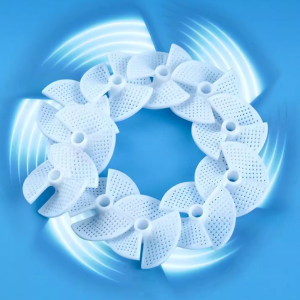
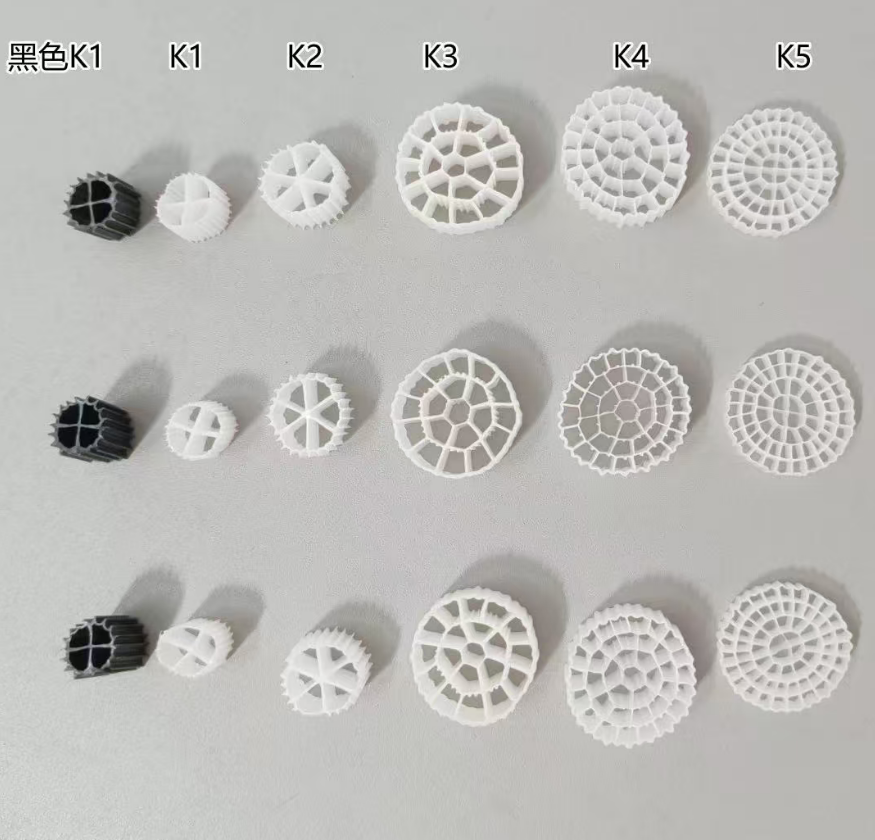
K1 and K3 MBBR (Moving Bed Biofilm Reactor) media are specialized "wheel-shaped" plastic carriers designed to provide a high protected surface area for beneficial bacteria to grow. These media are kept in constant motion by aeration, creating an efficient self-cleaning biological filter.
Key Technical Specifications
Feature K1 MBBR Media K3 MBBR Media
DesignSmall "cart-wheel" with 4 internal chambers Larger "cart-wheel" with more internal divisions
Typical Diameter Approximately 10 mm Approximately 25 mm
Surface Area ~500–800m2/m3 ~500–1,200m2/m3
Material Virgin High-Density Polyethylene (HDPE) Virgin High-Density Polyethylene (HDPE)
Core Benefits
Self-Cleaning Mechanism: The constant chaotic movement of the media causes the pieces to collide, knocking off old, dead biofilm and ensuring only active, young bacteria remain.
Protected Bio-Growth: The internal "spokes" of the wheel design protect the bacterial colonies from being sheared off by heavy water flow or air bubbles.
High Oxygen Transfer: Because the media is constantly fluidized by air, it ensures maximum oxygen contact for nitrifying bacteria, which is essential for breaking down ammonia and nitrites.
Scalability: You can easily increase the filtration capacity of an existing system by simply adding more media to the reactor tank.
Common Applications
Recirculating Aquaculture Systems (RAS): High-density fish farming where water quality is critical.
Koi Ponds and Water Gardens: Popular for maintaining crystal clear water in hobbyist setups.
Municipal Wastewater Treatment: Used in large-scale plants to upgrade biological capacity without building new tanks.
Industrial Water Treatment: Handling high-load organic waste in food processing or manufacturing.
Choosing Between K1 and K3
K1 is generally preferred for smaller filtration chambers or systems requiring higher precision, as the smaller size provides a better surface-area-to-volume ratio for compact tanks.
K3 is ideal for large-scale industrial or municipal systems where larger media is easier to contain with screens and requires slightly less energy to move in massive volumes of water.
Standard MBBR Media Nomenclature (K-Series)
K1 Media (Standard / Small-Scale)
Typical Dimensions: ≈11mm×7mm or 12mm×9mm
Structure: 4 to 5 internal chambers/rooms
Surface Area: ≈800--1,000m^2/m^3
Best For: Municipal wastewater treatment, recirculating aquaculture systems (RAS), and low-to-medium organic load environments where space is at a premium.
K2 Media (Medium-Flow)
Typical Dimensions: ≈12mm×10--12mm
Structure: Similar to K1, but with thicker walls or an added chamber spoke for increased structural durability.
Surface Area: ≈800"--" 1,000m^2/m^3
Best For: Nitrification/denitrification setups, fish farming, and medium-load applications requiring stronger resistance to shear forces.
K3 Media (Large-Chamber / Clogging-Resistant)
Typical Dimensions: ≈25mm×10--12mm
Structure: 19 internal chambers
Surface Area: ≈500"--" 650m^2/m^3
Best For: High-solids, high-BOD/COD industrial wastewater (dairy, paper, food processing, breweries). The large openings prevent fats, oils, and thick sludges from clogging the inner chambers.
K4 Media (Hybrid / Medium-Industrial)
Typical Dimensions: ≈25mm×10--12mm
Structure: 38 internal chambers
Surface Area: ≈800m^2/m^3
Best For: Medium-to-high industrial effluent where more surface area is needed than K3, but openings still need to remain large enough to resist clogging.
K5 Media (High-Surface / High-Density)
Typical Dimensions: ≈25mm×4mm (thin disc shape)
Structure: Up to 64 internal chambers/rooms
Surface Area: ≈1,200m^2/m^3
Best For: High-load COD/BOD applications (chemical/pharmaceutical waste, landfill leachate). The thin slice prevents inner chambers from suffocating due to dead biomass build-up under intense aeration.