Bridging the Hardware Gap: How Open-Source Motion Platforms Are Reshaping Simulation and Prototyping
In the rapidly evolving landscape of advanced automation and personal simulation, a quiet transformation has taken place. High-performance multi-degree-of-freedom (DOF) motion systems, precision linear actuators, and specialized mechatronic assemblies were once locked behind five-figure industrial price tags and proprietary ecosystems.
Today, engineers, industrial prototyping shops, and simulation enthusiasts are building high-grade, responsive motion platforms directly on their workbenches. At the heart of this shift is a fundamental manufacturing reality: open-source hardware designs succeed only when backed by an accessible, industrial-grade supply chain.
The Evolution: From Static Setups to Active Dynamics
Dynamic motion simulation is no longer restricted to flight academies or tier-one automotive testing centers. Whether replicating the telemetry of an endurance racer on the Nürburgring, testing stabilization algorithms for unmanned robotic arms, or training pilots in modular cockpits, direct force feedback and authentic kinematics are essential.
Building a dependable linear actuator requires solving several core engineering challenges:
Instantaneous Response with Zero Backlash: A motion simulator relies on rapid, high-frequency micro-movements to simulate surface rumble, traction loss, and sudden curb impacts. Standard timing-belt assemblies or low-lead acme screws cannot provide the requisite rigidity under dynamic loads.
Structural Rigidity Under Continuous Cyclic Stress: Unlike static CNC axes that experience predictable unidirectional cutting forces, motion platforms endure unpredictable multidirectional bending moments and sustained vibrations.
Thermal and Mechanical Reliability: Continuous high-torque duty cycles generate significant heat across servo motors and actuator casings, demanding efficient heat dissipation and robust mechanical tolerances.
Anatomy of an Actuator: Precision Components in Action
Projects like the community-driven SFX-100 system and commercial 3-DOF/6-DOF hexapod platforms proved that industrial automation components could be assembled into world-class consumer and commercial simulators. However, assembling a high-performance actuator requires strict tolerances across every link in the mechanical chain:
AC Servo Motor (750W–1kW)
│
[Zero-Backlash Coupling]
│
[Preloaded Ball Screw + Ground Shaft]
│
[Engineered Structural Extrusion Housing]
│
[Spherical Rod End / Industrial Leveling Mount]
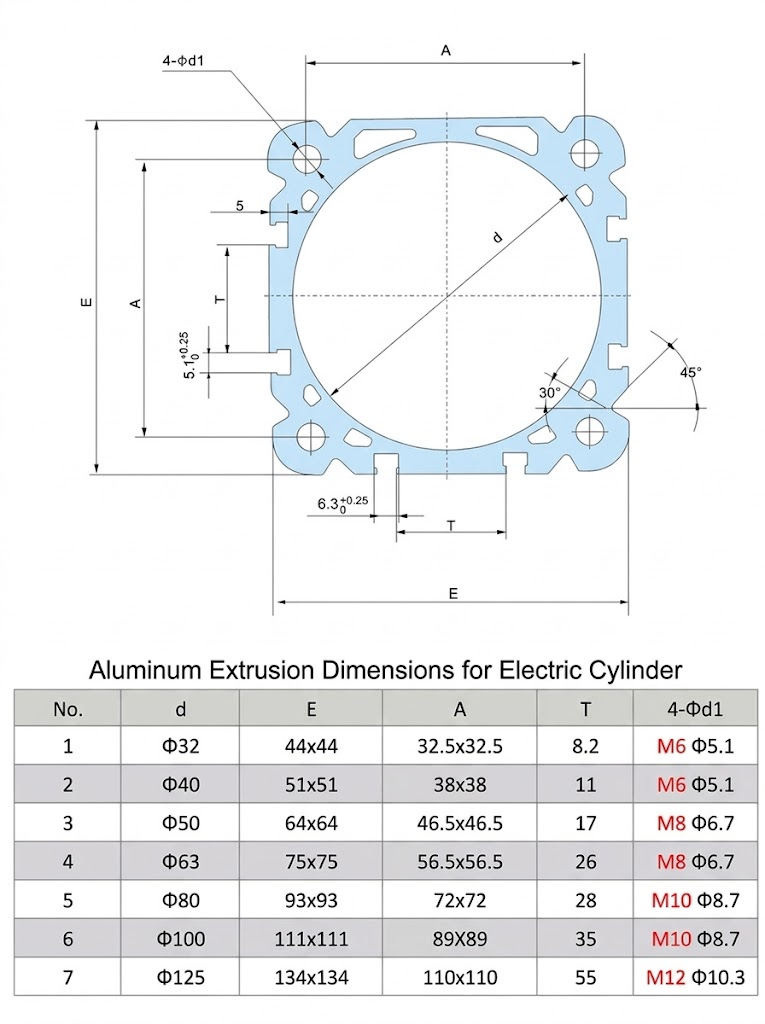
Custom Linear Extrusions: Off-the-shelf T-slot extrusions often lack internal structural ribbing and pre-tapped, heavy-duty mounting geometry (such as deep M14 threads). Extrusions engineered specifically for actuators provide integrated channels for anti-rotation sliders and recessed wiring, serving as both structural frame and linear guide shield.
Precision Ball Screws and Low-Friction Sliders: Pairing high-pitch rolled or ground ball screws (such as 1616 or 1620 leads) with linear ball bearings delivers high travel speeds (up to 250–300 mm/s) while preserving position repeatability within fractions of a millimeter.
Direct-Drive AC Servos: Modern industrial AC servos offer high pulse-rate resolution, integrated holding braking, and high peak torque curves needed to throw hundreds of kilograms of platform mass without skipping pulses or generating audible electrical whine.
The Power of Component Accessibility
For independent hardware builders, university labs, and nimble robotics startups, procurement has historically been a bottleneck. Sourcing custom-cut structural profiles from one local vendor, specialized metric couplings from another, and servo electronics from overseas often introduces lead-time friction, mismatched tolerances, and steep distributor markups.
By consolidating specialized extrusion profiles, CNC motor mounting plates, precision hardware, and dynamic controller boards into accessible inventories, platforms like RobotDigg have bridged the divide between industrial sourcing and rapid development. Builders can focus on kinematics, control firmware, and chassis dynamics rather than spending weeks sourcing metric adapter fasteners and specialized bearing mounts.
What’s Next: The Rise of Modular Motion
As compact brushless DC systems, high-speed field-oriented control (FOC) drivers, and rapid additive manufacturing continue to mature, the barriers to deploying dynamic motion hardware will fall even further.
The future belongs to modular, plug-and-play mechatronic building blocks. Whether you are constructing a four-actuator surge-and-pitch sim rig, an automated vertical test stand, or a custom Cartesian gantry, combining open architecture with dedicated precision hardware turns ambitious CAD sketches into moving reality.
Recent post:
- Servo Press vs Pneumatic Press: How to Choose the Right Manufacturing Solution for Your Assembly Line
- Upgrade Your Automation: Lightweight Stepper Motorized Linear Actuators from RobotDigg
- Understanding Press Types: Pneumatic, Hydraulic, and Servo Drive Configurations
- Bridging the Hardware Gap: How Open-Source Motion Platforms Are Reshaping Simulation and Prototyping
- Engineering Cost Breakdown: How Pitch and Groove Depth Drive Reversing