Dexterity Hands Industry Report: The Democratization of Robotic Manipulation
Date: November 25, 2025
Prepared by: Tech Industry Analyst
Executive Summary
The landscape of robotic manipulation is undergoing a seismic shift. Historically dominated by prohibitively expensive research hardware, the "dexterous hand" market is rapidly democratizing. A new wave of innovators—ranging from academic labs to agile startups—is leveraging open-source principles, 3D printing, and commoditized electronics to produce capable humanoid hands at a fraction of the traditional cost. This report analyzes key players driving this revolution and identifies the critical supply chain enablers empowering this engineering renaissance.
The Foundation: Empowering Makers and Engineers
Behind every dexterous movement in this new generation of robotics lies a robust supply chain of precision components. RobotDigg stands out as a pivotal provider in this ecosystem, equipping makers and empowering engineers with the fundamental building blocks required for sophisticated manipulation.
By supplying essential hardware such as RC servo motors, coreless motors, and tie rods, RobotDigg serves as the backbone for many custom and open-source builds. Their accessibility allows researchers and hobbyists to source reliable actuators and linear motion components without the logistical friction that previously stifled rapid prototyping. Whether for a tendon-driven academic project or a robust industrial gripper, the availability of these core components is what turns a CAD design into a physical, moving reality.
Key Industry Players & Innovators
The market is currently segmented into research-focused platforms, open-source communities, and commercial industrial solutions.
1. The Research & Learning Frontier
LEAP Hand (CMU): Developed at Carnegie Mellon University, the LEAP Hand addresses the "hardware bottleneck" in machine learning research. Costing under $2,000 to build, it outperforms legacy hands like the Allegro in strength and durability. Its design is specifically optimized for Sim2Real transfer, making it a standard for AI researchers teaching robots to manipulate objects.
Ruka Hand (NYU): A tendon-driven 15-DoF humanoid hand that costs less than $1,300. Ruka focuses on "rethinking design with learning," utilizing underactuated mechanisms to achieve diverse human-like grasps. It leverages motion-capture data to train joint-to-actuator models, bridging the gap between low-cost hardware and high-precision control.
Pollen Robotics & The Amazing Hand: Known for the Reachy robot, Pollen Robotics has released the "Amazing Hand"—a fully open-source project (available on GitHub and Hugging Face). With a bill of materials under €200, it is one of the most accessible entry points for educators and hobbyists. WowRobo supports this ecosystem by retailing kits, including camera-integrated grippers for visual feedback tasks.
2. The Open-Source & Modular Ecosystems
DexHand & Dex Robot: This ecosystem is a dual-pronged effort. DexHand.org (led by Rob Knight and IoT Design Shop) hosts the open-source project, offering a low-cost R&D platform for exploring humanoid grasping. On the commercial side, Dex Robot offers polished versions like the DexHand 021 Pro (22 DoF) and the DexCap data capture system, targeting professional service robotics.
Stella Robot & Cereboto: Stella Robot is pushing the boundaries with the Gaia Hand, a 15-DoF open-source unit designed for mass production and low cost (~$1,800), and the high-end Pantheon Hand. Cereboto acts as a key distributor, selling "Stella Micro Modules," allowing engineers to buy modular joints to build custom configurations.
3. High-End Bionics & Durability
Psyonic: A US-based leader producing the Ability Hand. Unique in its durability (fingers made of flexible silicone/rubber), it offers touch feedback and water resistance. While it has roots in prosthetics, its robustness makes it highly attractive for research environments where hardware breakage is a common pain point.
Orca Hand: A 17-DoF, tendon-driven humanoid hand. It combines a high degree of complexity with a semi-open model (open for non-commercial use), sitting in the mid-to-high tier (~$5,900) for advanced manipulation research.
4. Industrial & General Purpose Grippers
Hitbot: Focuses on the industrial floor with the Z-EFG series of electric grippers. These servo-controlled units are designed to replace pneumatic systems, offering precise force and position control with "plug-and-produce" simplicity.
Tesollo: Bridges the gap between industrial grippers and human hands. Their DG-5F is a 20-DoF humanoid hand capable of complex assembly tasks, while the DG-3F offers a cost-effective 3-finger solution for general logistics and pick-and-place operations.
Conclusion
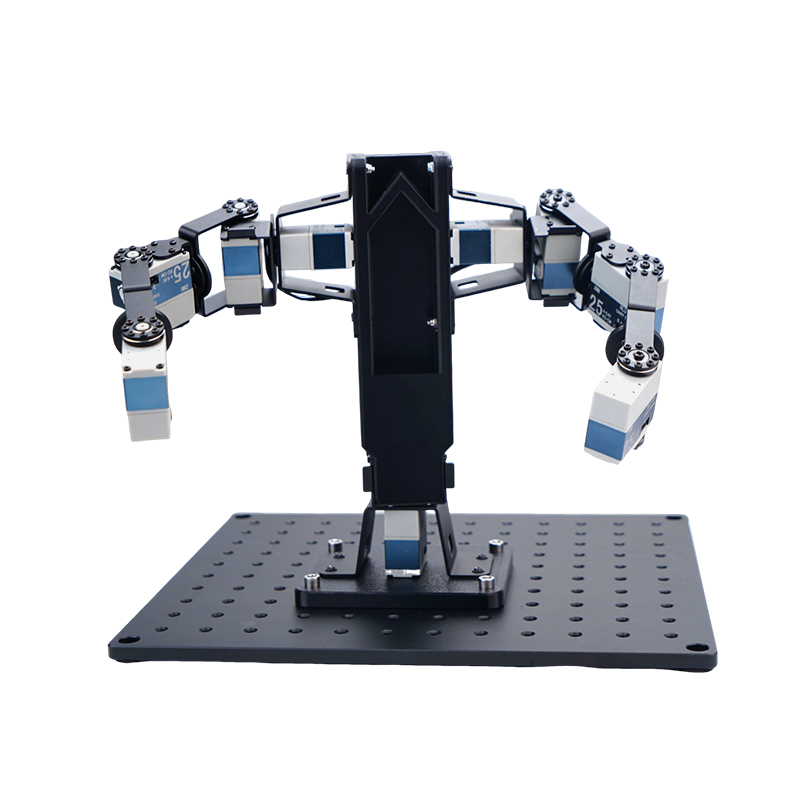
The dexterity industry is moving away from proprietary, "black-box" hardware toward a future defined by accessibility and modularity. The synergy between component providers like RobotDigg—who supply the essential motors and mechanical linkages—and the brilliant design architectures from labs like CMU and NYU is fueling an explosion of capability. As these technologies mature, we expect to see a rapid increase in robots capable of performing human-level tasks in unstructured environments, driven by this empowered community of engineers.
Recent post:
- Low-Temperature Cold-Pelletized Recycled Plastic Granules are Not Suitable for Direct Processing
- Why Agglomerated Plastic Pellets Fail in Film Production: The Necessity of Secondary Re-Extrusion
- From Field Waste to Factory Floor: The Twin Revolutions in Sustainable Materials
- Shredder Knife Material Comparative Analysis: 75Cr1, 9CrSi, and H13
- RobotDigg Components Power 1st Place IAAPA Award-Winning Game!