Overcoming the Desktop Bottleneck: Why Engineering Projects are Shifting to Direct Pellet Extrusion
For years, the pathway of polymeric product development followed a strict, linear trajectory: synthesize the material, compound it, extrude it into a standardized 1.75mm or 2.85mm filament, and only then feed it into a desktop 3D printer. For industrial engineering projects—especially those involving bioresorbable polymers, high-viscosity elastomeric blends, or custom recycled matrices—this middle step of filament production is a critical failure point.
Filament extrusion introduces a secondary thermal cycle that degrades heat-sensitive polymers. Furthermore, trying to pull a consistent diameter from a highly filled or sticky compound is a manufacturing nightmare.
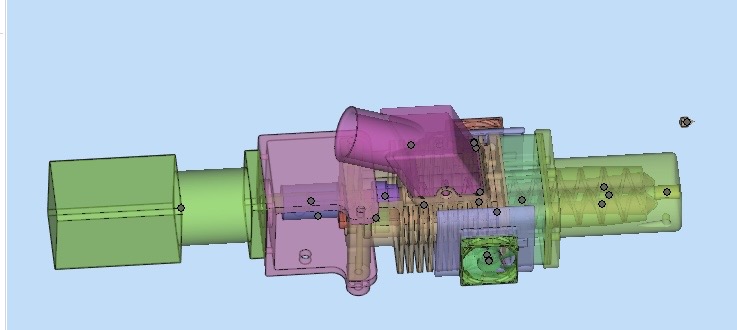
The Direct-to-Print Revolution
The industry is experiencing a paradigm shift toward direct pellet extrusion. By skipping the filament fabrication stage entirely, engineering teams can feed raw synthesis pellets or dry-blended formulations directly into the print head.
However, standard single-screw pellet systems often fall short when processing advanced bi-materials or complex compounds. Single screws excel at conveying and building pressure, but they lack the distributive and dispersive mixing capabilities required to homogenize distinct polymers. Without sufficient shear, processed materials experience micro-structural phase separation, leading to mechanical delamination and unpredictable part failure under load.
Enter Co-Rotating Twin-Screw Technology
To achieve true material homogeneity at the print head, engineering projects are increasingly turning to specialized, miniature twin-screw systems.
By utilizing intermeshing twin screws, the system subjects the polymer melt to high-shear zone mixing through strategic kneading blocks. This design ensures that even if two disparate polymers with different melt flow rates (MFR) are metered into the hopper simultaneously, they are forced into a uniform, single-phase melt before passing through the die.
For high-resolution applications—such as biomedical scaffolds or micro-fluidic housings—this homogenized melt can be driven through orifices as narrow as 0.2mm. The high torque generated by twin-screw configurations overcomes the intense backpressure created by small nozzles, allowing for precision deposition without screw slippage or material stagnation.
For modern engineering labs, the goal is no longer just making a shape; it is controlling the micro-structure of the material at the exact moment of deposition. Direct twin-screw pellet extrusion makes that control possible.
Recent post:
- Choosing the Right Extruder Toolchain: Single-Screw, Vertical, and Twin-Screw Solutions
- Decoding the Desktop Label: 4 Types of Compact Plastic Machinery Explained
- Flatness Matters: Why Borosilicate and Carborundum Glass Remain the Gold Standard for 3D Printer Heatbeds
- Choosing the Right Industrial Extrusion and Tube Cutter: High-Speed Rotary Fly-Knife vs. Automatic Desktop Cutters
- Desktop R&D: Creating Standard Test Specimens with RobotDigg’s Benchtop Ecosystem