Choosing the Right Extruder Toolchain: Single-Screw, Vertical, and Twin-Screw Solutions
The demands of desktop manufacturing, laboratory research, and large-format 3D printing have pushed traditional plastic extrusion hardware to adapt. While horizontal single-screw extruders remain the standard for simple manufacturing pipelines, modern production often requires specialized form factors and varying screw mechanics.
RobotDigg’s latest lineup provides hardware ecosystems engineered to solve distinct manufacturing constraints—from space optimization to custom material compounding.
The Baseline: Standard Horizontal Filament Extrusion
For custom or low-volume 3D printing filament production, the standard horizontal pipeline is the traditional starting point. A system like the RobotDigg SJ35 Extruder (Product 1752) uses a horizontal single screw to melt and transport pre-formulated resin pellets through a forming die.
In this conventional layout, the molten plastic strand is mechanically pulled horizontally through a water cooling trough or across an air-cooling conveyor by a motorized puller (haul-off unit) before being wound onto a spool. This system is efficient for high-yield, single-material runs where ample workshop floor length is available.
Reimagining Form Factor: Vertical Filament Extrusion
When floor space is limited, or mechanical pullers risk deforming sensitive geometries (such as soft tubing or flexible filaments), horizontal lines hit a physical boundary.
The RobotDigg SJ15V Extruder (Product 2187) flips the traditional horizontal layout on its side. By orienting the barrel, hopper, and die completely perpendicular to the floor, this vertical design introduces several process advantages:
Gravity-Assisted "Draw-Down": The system entirely eliminates the need for a mechanical belt puller. Gravity acts as the tensioning force, naturally stretching the descending strand.
Flawless Concentricity: Because the extruded material cools uniformly in mid-air via an ambient air-cooling loop rather than resting heavily on a horizontal surface or sinking in a water tank, it eliminates flat spots.
Compact Footprint: By leveraging vertical ceiling height instead of floor space, these units easily fit into small laboratory stations or mobile workshop environments.
Direct-Drive Performance: Large-Format Pellet Extruders
The vertical architecture of single-screw extruders has opened up new applications in large-format additive manufacturing (LFAM). Modern industrial 3D printing frequently bypasses pre-made filament altogether, opting instead to feed raw plastic pellets directly into an extruder head mounted on a gantry or robotic arm.
The RobotDigg SJ25V Stepper-Driven Extruder (Product 2188) is specifically engineered for this direct-drive purpose. Upgraded with a high-torque planetary-geared stepper motor, it gives automated motion systems micro-step control over the extrusion velocity. This precision allows large-scale 3D printers to dynamically scale flow rates to match acceleration curves, turning raw pellets into structural parts without the material overhead of traditional filament processing.
Mounting an extruder onto a dynamic movement system like a 6-axis robotic arm introduces severe weight and flow-control constraints. The RobotDigg 2188 addresses this via a compact, high-output vertical form factor. Weighing just 6 kg at the print head, it balances structural agility with industrial-grade throughput.
Operating up to 350°C with 1 kW of thermal power, the unit achieves an extrusion capacity of 3 kg per hour. Pellets are fed via an active vacuum suction line into a newly designed sloped gravity throat, preventing material jams. This setup allows industrial prints—like automotive molds or architectural panels—to be laid down via wide 1.5mm to 3mm nozzles in fractions of the time standard filament printers require.
The Compounding Core: Industrial Twin-Screw Production
While direct single-screw extruders excel at pumping uniform, raw pellets (like pure PLA or PETG), they struggle with material innovation. If your industrial application requires custom-blended carbon fiber reinforcers, specialized color masterbatches, or upcycled post-consumer flake matrices, a single screw cannot provide the necessary mechanical mixing.
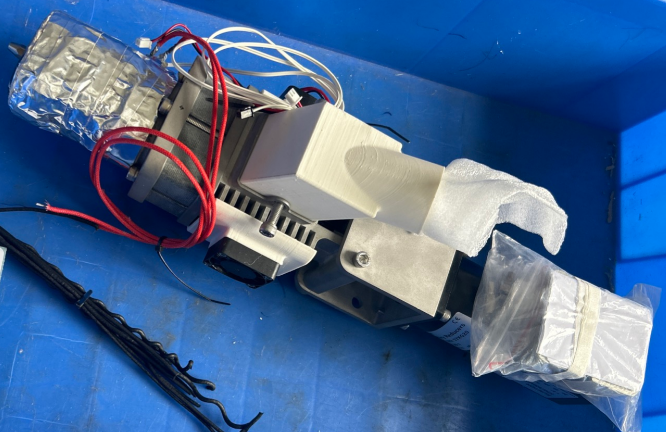
The RobotDigg 2306 Twin-Screw System acts as the material foundry for LFAM operations. By utilizing dual intermeshing, co-rotating screws inside a figure-eight barrel, it transforms raw material processing:
High Shear Homogenization: The intermeshing screw flights trap and pass the molten polymer through extremely tight gaps. This mechanical shearing action tears apart pigment agglomerates and distributes structural additives (like chopped glass fiber) flawlessly without snapping the fibers.
Positive Displacement Flow: Single screws rely entirely on barrel friction to slide material forward. Slippery or sticky material blends can experience "feeding stall." Twin screws physically lock the material between alternating flights, forcing it forward continuously regardless of the blend's friction properties.
By pairing the compounding capabilities of the Twin-Screw 2306 with the responsive, high-velocity delivery of the Servo-Driven 2188, print facilities can design, mix, and print custom-engineered industrial components completely in-house.
Recent post:
- Mastering Precision: Choosing the Right Controller and Feeder for Your Automation Pilot
- Navigating the Perfect Storm: Why RobotDigg’s Ecosystem is Built for the New Era of Global Hardware
- The Solid-State Revolution: How SSR, SST, and SSB Are Redefining Modern Automation and Robotics
- Avoiding SMT Failures: Why Coplanarity Check is Critical for High-Yield PCB Assembly
- Embracing the Crunch: Mastering Heat Treatment and Geometry for SKD61 and Nitrided Steels