Understanding Press Types: Pneumatic, Hydraulic, and Servo Drive Configurations
In custom automation, hardware prototyping, and industrial assembly, selecting the ideal force-application machinery depends on balancing force, speed, precision, and efficiency. Modern presses are defined both by their drive technology (how force is generated) and their frame structure (how force is distributed).
At RobotDigg, understanding these mechanisms helps you select or construct the right press system for your production line.
Core Press Drive Technologies
Pneumatic Presses (Air-Driven)
How It Works: Uses compressed plant air ($0.4 - 0.8\text{ MPa}$) to actuate a pneumatic cylinder.
Advantages: High stroke speed, simple mechanical design, low upfront cost, and zero oil contamination.
Best Used For: High-speed, light-to-medium tasks 100kg to 5tons such as PCB depaneling, light stamping, riveting, and terminal crimping.
Hydraulic Presses (Fluid-Driven)
How It Works: Uses a motor-driven hydraulic pump to pressurize hydraulic oil, driving a heavy-duty piston.
Advantages: Generates immense force in a compact footprint, maintains constant tonnage throughout the entire stroke, and handles high-load operations effortlessly.
Best Used For: Heavy-duty forming, deep drawing, metal forging, and high-tonnage press-fitting 5tons to over 1,000tons.
Servo Presses (Electric/Motor-Driven)
How It Works: Uses an AC servo motor paired with a high-precision ball screw or planetary roller screw to drive the ram down directly.
Advantages:
Full Programmability: Precise control over position, speed, and force down to the micrometer level.
Real-Time Data Logging: Monitors load-vs-displacement curves during every press cycle for 100% quality assurance.
Energy Efficient: Consumes power only during active movement, operating silently and cleanly.
Best Used For: High-precision automotive component press-fitting, aerospace assembly, medical device manufacturing, and smart factory integrations (Industry 4.0).
Structural Frame Configurations
Regardless of whether a press is powered by pneumatics, hydraulics, or a servo motor, it generally utilizes one of five common frame designs:
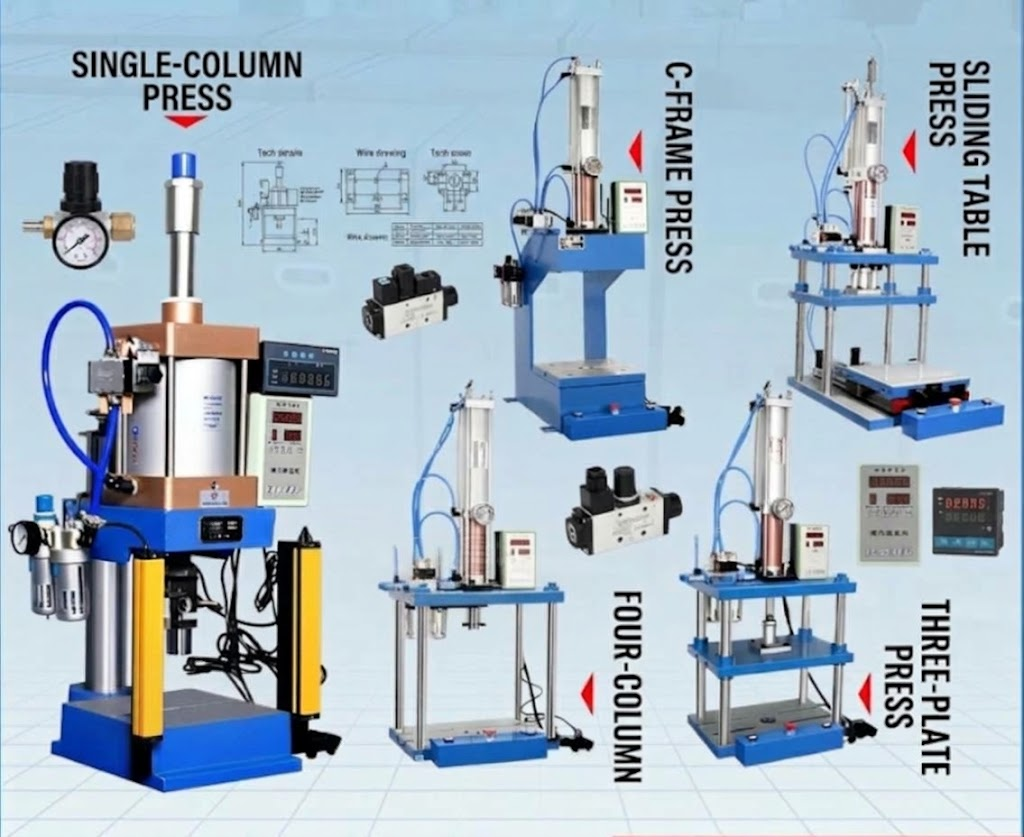
Single-Column / Single-Pillar Press
Design: Built around a single vertical support column behind or beside the working platen.
Key Feature: Excellent 360 accessibility around the work area with a compact footprint.
Applications: Micro-assembly, small terminal crimping, and laboratory testing.
C-Frame Press
Design: Features an open "C" shape frame, leaving the front, left, and right sides open.
Key Feature: Easy access for operators or robotic arms to feed material into the die area from multiple angles.
Applications: Sheet metal punching, stamping small brackets, and component pressing.
Sliding Table Press
Design: Integrates a press cylinder/ram above a linearly sliding shuttle bed.
Key Feature: Maximizes operator safety—parts are loaded onto the sliding table outside the press zone before being moved under the ram.
Applications: Inserting heat-set brass inserts into 3D prints, plastic enclosure staking, and manual multi-component assemblies.
Four-Column / Four-Pillar Press
Design: Utilizes four corner guide pillars connecting the top drive plate to the base plate.
Key Feature: Exceptional frame rigidity and equal load distribution, preventing die tilting during high-force pressing.
Applications: Precision die cutting, surface embossing, and balanced deep drawing.
Three-Plate Press
Design: Uses a three-plate guided structure (top plate, middle moving platen, and bottom bed) sliding along precision vertical shafts.
Key Feature: High precision and rigidity for guided vertical motion, ideal for lighter precision pressing setups.
Applications: Precision punching, cleanroom assembly, and delicate connector pressing.
Recent post:
- The Rise of China’s "Surge Price Slashers": How Fresh Graduates Are Rewriting Solopreneurship
- Servo Press vs Pneumatic Press: How to Choose the Right Manufacturing Solution for Your Assembly Line
- Upgrade Your Automation: Lightweight Stepper Motorized Linear Actuators from RobotDigg
- Understanding Press Types: Pneumatic, Hydraulic, and Servo Drive Configurations