Servo Press vs Pneumatic Press: How to Choose the Right Manufacturing Solution for Your Assembly Line
When optimizing a small-to-medium automated production line or upgrading your workshop's desktop processing equipment, choosing the right pressing machine is a critical decision. Whether you are performing punching, riveting, assembling, bending, extruding, or shearing, selecting between a Servo Press and a Pneumatic Press directly impacts your product quality, production efficiency, and return on investment (ROI).
At RobotDigg, we provide versatile desktop and industrial press solutions tailored to your automation needs. Here is a comprehensive guide to help you decide which press fits your workflow best.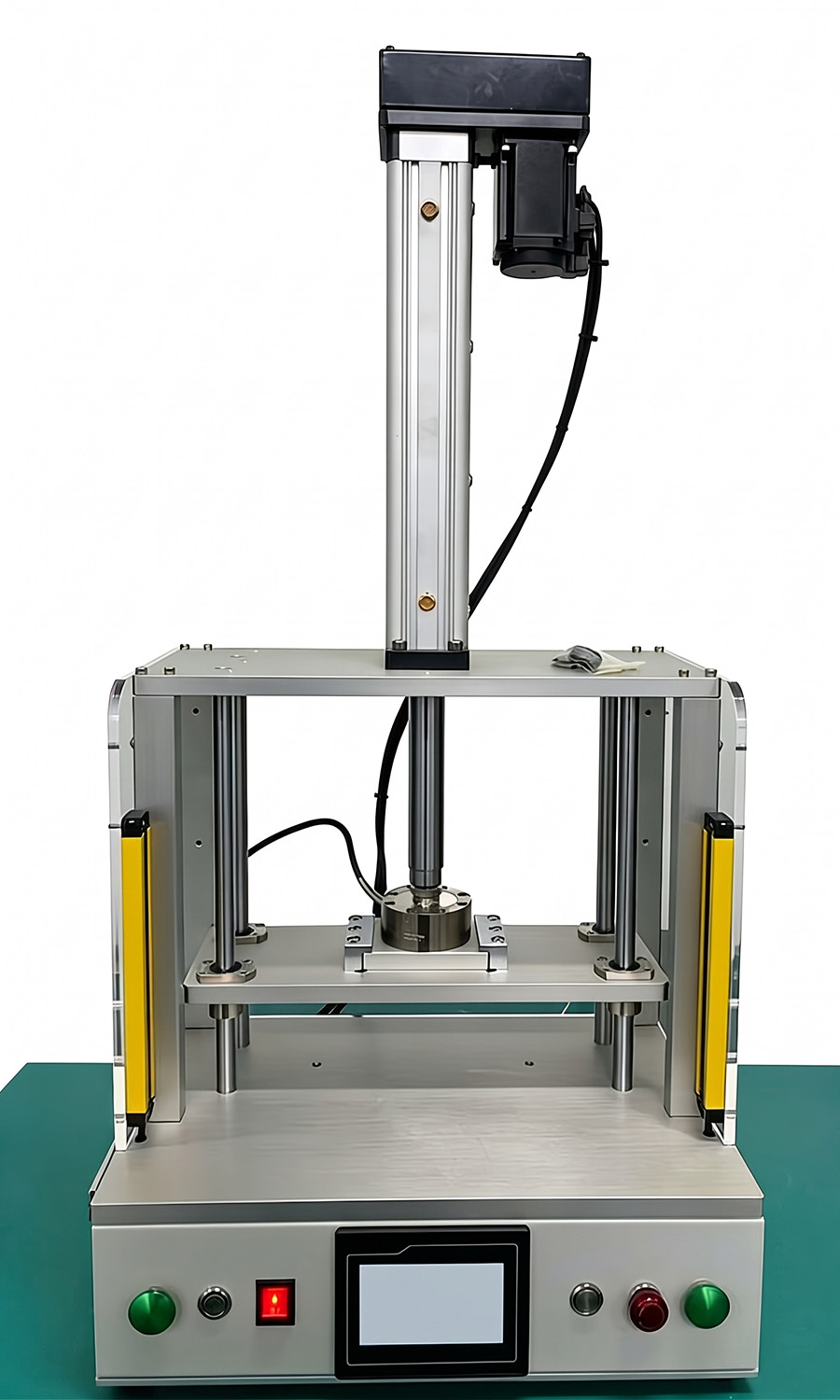
Core Operating Principles
Pneumatic Press: Powered by compressed air, pneumatic presses utilize air cylinders to generate vertical force. They offer fast, straight stroke movements and high cycle speeds, making them a popular budget-friendly choice.
Servo Press: Driven by a high-precision servo motor through a ball screw mechanism, a servo press allows full closed-loop control over speed, displacement, and output force throughout the entire stroke.
Process Performance Breakdown
Manufacturing Process Recommended Press Why It Matters
Riveting Servo Press Requires accurate depth and target force control to prevent loose rivets or part deformation.
Assembly / Press-Fit Servo Press Interference fit (bearings, bushings, pins) requires real-time force-displacement monitoring to ensure 100% assembly yield.
Bending Servo Press Excellent for controlling bottom dead center (BDC) position and dwell time, effectively compensating for material springback.
Extruding & Forming Servo Press Smooth force output and programmable dwell times prevent micro-cracks in sensitive materials.
Punching & Shearing Pneumatic Press Ideal for thin sheet metals where fast impact force and high cycle speed are required at a low operational cost.
Key Advantages of Servo Presses
Unmatched Precision & Repeatability: Offers displacement precision up to $\pm0.01\text{ mm}$ with controllable dynamic pressing profiles.
Real-Time Quality Control & Data Logging: Captures real-time Force vs. Displacement (F-S) curves, enabling automated pass/fail inspection and full traceability for Industry 4.0 applications.
Energy Efficiency & Quiet Operation: Consumes power only during the active pressing stroke, reducing energy overhead compared to continuously running air compressors.
When Should You Stick to a Pneumatic Press?
Budget Sensitivity: Lower initial purchasing cost and minimal control complexity.
Simple Punching/Cutting: Highly effective for basic sheet metal blanking, hole punching, or cutting where depth control isn't critical.
High-Speed Repetitive Tasks: Excellent stroke rate for straightforward, low-tonnage press jobs.
Finding the Right Equipment with RobotDigg
From C-Frame desktop servo presses (100kg to 20T) to Four-Column Three-Plate configurations, RobotDigg supports hardware developers, factory integrators, and engineering teams with reliable components and turn-key desktop machinery.
Need precision quality control and data logging? Choose a RobotDigg Servo Press.
Need a fast, affordable solution for simple punching and cutting? Opt for a Pneumatic setup.
Recent post:
- Lighter, Cheaper, Cleaner: Why Bamboo Composites Are Challenging Carbon Fiber
- Mastering Twin Screw Extrusion: Parallel, Modular, Conical, and Pellet Systems Explained
- Precision Roller Solutions for Industrial Packaging, Coating, and Film Extrusion
- Driving Precision: How RobotDigg Powers the Next Generation of Sim Racing
- The Rise of China’s "Surge Price Slashers": How Fresh Graduates Are Rewriting Solopreneurship