Mastering Twin Screw Extrusion: Parallel, Modular, Conical, and Pellet Systems Explained
In modern polymer processing, 3D printing filament production, and plastic recycling, the choice of extrusion technology dictates product quality, output efficiency, and material compatibility. While single-screw extruders are suitable for basic melting and pumping tasks, twin screw extruders provide the superior torque, precise shear control, and high mixing capability required for advanced applications.
When selecting or designing an extrusion setup with RobotDigg hardware, understanding the core differences between parallel twin screws, modular twin screws, conical twin screws, and twin screw pellet extruders is essential for optimizing your processing pipeline.
Parallel Twin Screw Extruders: The Benchmark for Processing Consistency
A parallel twin screw extruder features two screws of constant, uniform outer diameter running along the entire length of the barrel.
Design Mechanism: The center-to-center distance between the twin shafts remains identical from the feed throat to the exit die.
Key Advantages: Parallel twin screws offer predictable residence times, a consistent processing volume, and uniform heat transfer over extended barrel lengths (high L/D ratios).
Primary Applications: Continuous compounding, film and sheet extrusion, plastic recycling, and high-volume material processing.
Modular Twin Screw Extruders: Ultimate Process Flexibility
Rather than being machined as a single, solid metal bar, a modular twin screw (segmented screw) uses a "building block" architecture built around parallel co-rotating shafts.
Design Mechanism: Individual functional elements—such as forward-conveying screws, 45°/90° kneading blocks, tooth-mixing elements (TME/SME), and reverse sealing elements—are slid onto a splined core shaft in a tailored sequence. The barrel is similarly divided into customizable heating, feeding, and vacuum degassing zones.
Key Advantages:
Custom Shear Profiles: Easily adjust the configuration when switching between different polymers (e.g., from HDPE to water-sensitive PET or fiber-reinforced PA66).
Cost-Effective Maintenance: If wear occurs in a localized high-shear melting zone, only the worn individual screw blocks need replacing, avoiding the expense of a full screw replacement.
Primary Applications: R&D laboratories, multi-component compounding (3–5 raw materials), masterbatch manufacturing, and filled polymer development.
Conical Twin Screw Extruders: High Pressure for Heat-Sensitive Resins
Unlike parallel systems, a conical twin screw extruder features screws that taper in diameter—starting large at the feed throat and narrowing significantly toward the discharge end.
Design Mechanism: The screws are almost exclusively counter-rotating. The large diameter at the feed section delivers high torque and a broad surface area for raw material intake, while the decreasing diameter at the exit generates strong physical compression and high extrusion pressure.
Key Advantages: Conical extruders build high head pressure at lower rotational speeds (RPM), subjecting the material to low shear rates and preventing thermal degradation.
Primary Applications: Rigid PVC (RPVC) processing, PVC pipe and profile extrusion, Wood-Plastic Composites (WPC), and processing heat-sensitive polymer powders.
Twin Screw Pellet Extruders: Direct Material Processing & Direct-3D Printing
A twin screw pellet extruder integrates a twin-screw melting drive directly into a compact pellet-feeding system. This design is widely utilized in both industrial pelletizing lines (strand pelletizers) and direct-drive Pellet 3D Printing (FGF / Fused Granular Fabrication).
Design Mechanism: Instead of feeding pre-extruded filament, the machine feeds raw plastic pellets, flakes, or regrind directly into a miniaturized twin-screw barrel.
Key Advantages:
Direct Cost Savings: Raw polymer pellets and recycled regrinds are significantly less expensive than manufactured 3D printer filament spools.
In-Situ Compounding: Mix raw polymers, color pigments, carbon fiber, or additives directly inside the print head or pelletizing barrel prior to extrusion.
High Throughput: Twin-screw pellet extruders achieve significantly higher melt flow rates than traditional single-screw hotends, enabling large-format additive manufacturing.
Primary Applications: Industrial pelletizing, direct-pellet 3D printing (FGF), color masterbatch sampling, and closed-loop plastic recycling.
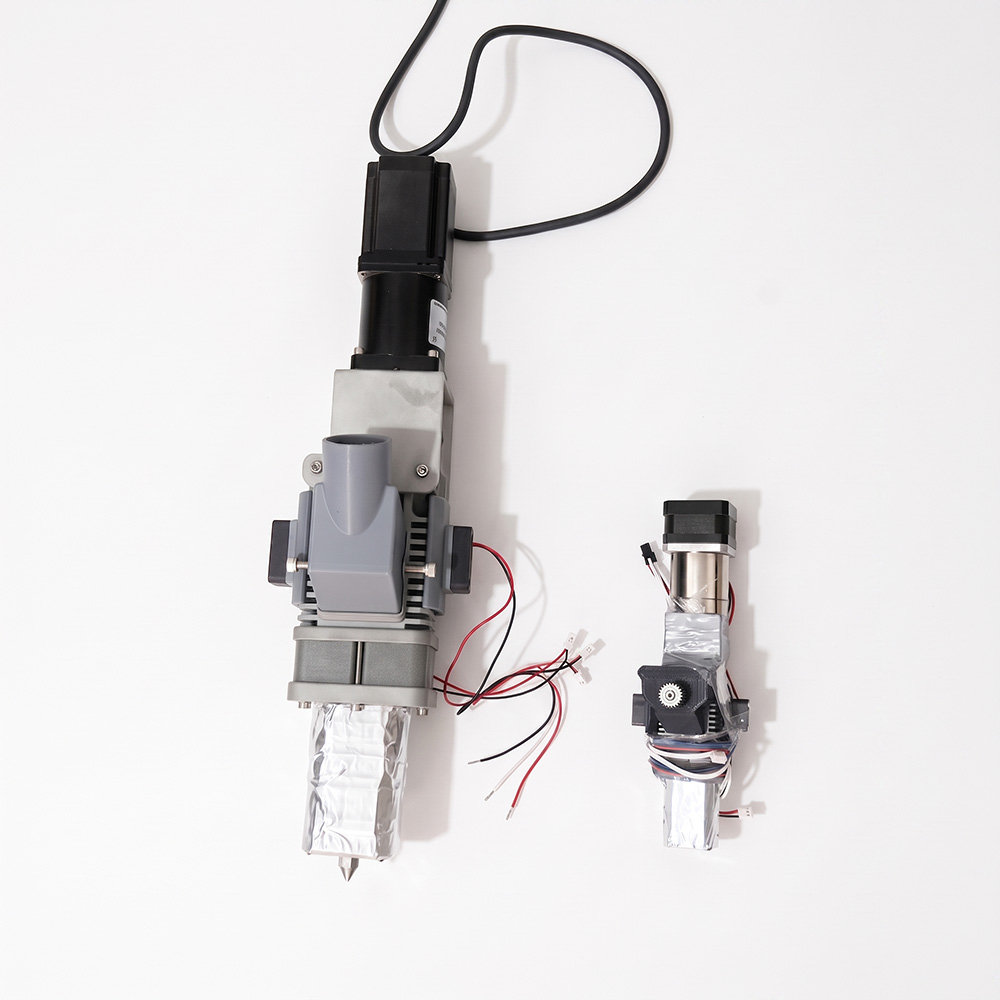
Build Your Extrusion System with RobotDigg
Whether you are assembling a laboratory-scale modular compounding line, optimizing a pellet 3D printer, or retrofitting custom screw components, RobotDigg provides the precision motion hardware, high-torque drive motors, bimetallic barrels, custom screw elements, and band heating systems required to bring your project to life.
Recent post:
- Desktop R&D: Creating Standard Test Specimens with RobotDigg’s Benchtop Ecosystem
- Overcoming the Desktop Bottleneck: Why Engineering Projects are Shifting to Direct Pellet Extrusion
- Mastering Level Wind Screws: How to Select the Ideal Materials, Surface Treatments, and Pawl Pairings for Peak Performance
- Building an OpenPnP Pick and Place Machine? How to Integrate RAY Feeders via RS-485
- Lighter, Cheaper, Cleaner: Why Bamboo Composites Are Challenging Carbon Fiber