Closing the Loop: Converting PET Bottle Flakes into High-Value
In the modern manufacturing landscape, the transition from waste to resource is no longer a luxury—it’s a necessity. At RobotDigg, we are empowering engineers and small-to-medium enterprises (SMEs) to lead this circular economy with our specialized PET Fiber Extrusion Lines.
Whether you are producing high-end bedding or industrial-grade insulation, understanding the journey from a PET flake to a soft, fibrous "silk" is key to optimizing your production.
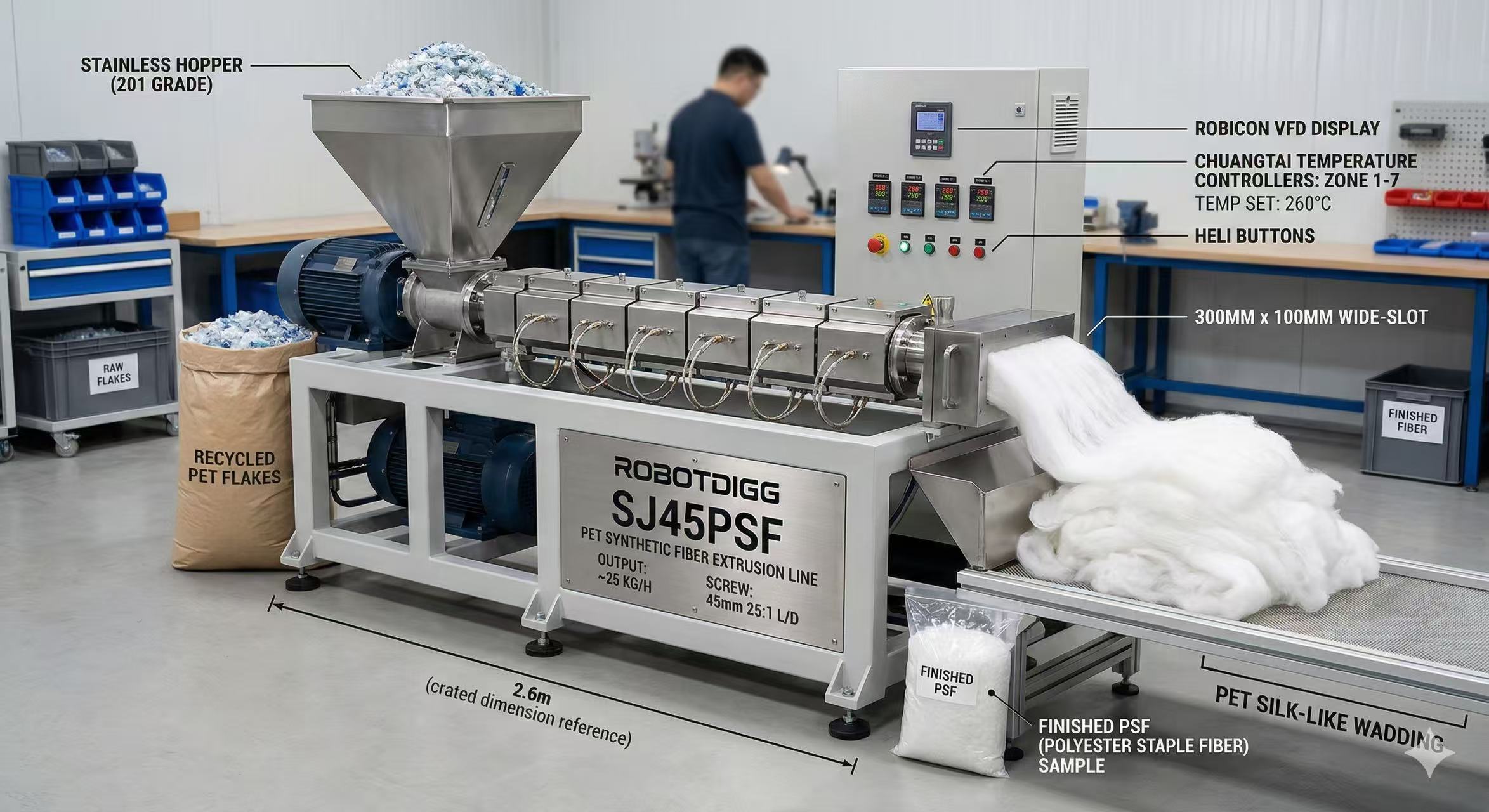
(The photo is by Gemini, not the real one which is for reference only!)
From Waste to Wadding: The Process
Our extrusion lines, such as the high-output SJ45PSF, are engineered specifically to handle the unique rheological properties of recycled PET bottle flakes. Unlike traditional spinning which produces rigid monofilament, these lines utilize a "blown" process to create a soft, cotton-like mass known as Polyester Staple Fiber (PSF).
The Technical Core: SJ45PSF vs. SJ30PSF
Choosing the right equipment depends on your required scale and the final application of the fiber.
Feature SJ30PSF (Desktop/Lab Scale) SJ45PSF (Industrial Production)
Output 7 kg/h 25 kg/h
Screw L/D Ratio 10:1 25:1 (High homogenization)
Main Motor 3 kW 22 kW
Heating Zones 5 Zones 7 Zones (Precision Control)
Applications R&D, small-scale artisan crafts Industrial pillows, jackets, filtration
Key Engineering Highlights
1. Superior Metallurgy (38CrMoAlA)
Recycled PET flakes can be abrasive. To ensure long-term precision, our screws and barrels undergo Quenching, Tempering, and Nitriding. This surface hardening allows the machine to maintain consistent pressure even when processing 100% recycled content.
2. The "Blown" Advantage
What differentiates our PSF lines from standard extruders is the integrated High-Pressure Air-Heater Zone. As the molten PET exits the 300mm wide die, a targeted stream of high-pressure hot air attenuates the melt. This "blows" the plastic into fine, curly fibers, creating the signature soft, "silk-cotton" texture required for thermal insulation and high-loft fillings.
3. Precision Thermal Management
With up to 7 heating zones managed by Chuangtai temperature controllers, the SJ45PSF ensures that the PET remains within its narrow processing window. This prevents thermal degradation (yellowing) and ensures the final fiber maintains a high "whiteness" and "bounce."
Applications of PET "Silk-Like" Fiber
Textile & Apparel: Eco-friendly "down-alternative" padding for winter jackets.
Home Furnishings: High-loft filling for pillows, duvets, and mattresses.
Automotive: Sound-dampening felt and interior insulation.
Filtration: Specialized non-woven mats for air and water purification.
Recent post:
- Why Tank-Style Chillers Aren't Always Best for Extrusion Lines
- Revolutionizing Biochip Production: The Seamless Integration of CO2 Foamed PE Cores and Outer Envelopment
- Why Fly-knife Rotary Cutters Use Utility Blades as Cutting Tools
- Deep Dive: Specialized Components of the CO2 Injection System
- Advanced R&D Pilot Line: Bridging Compounding and Film Production